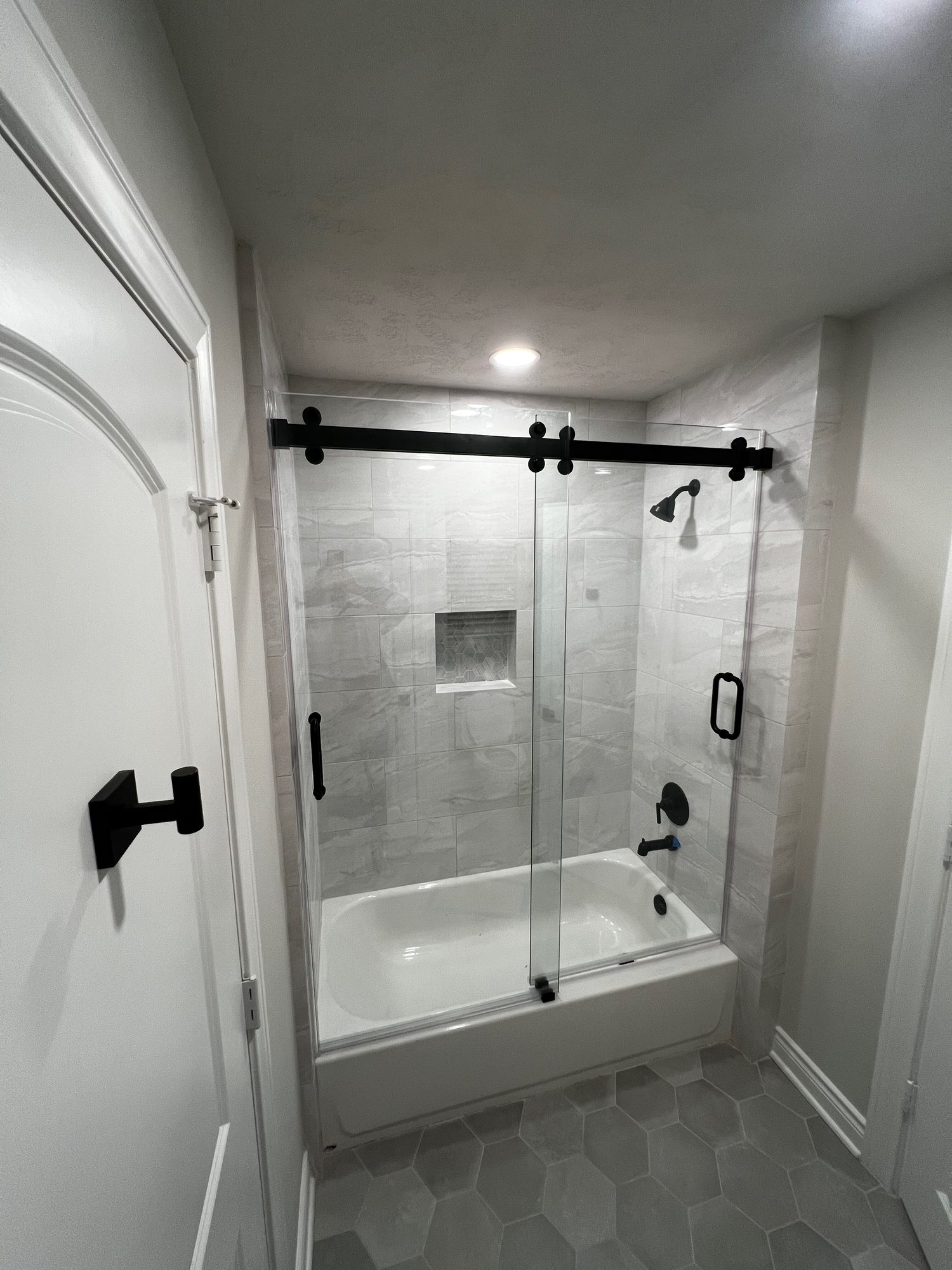
If you're replacing a shower enclosure, one of the first decisions is how the door actually opens. The two most common frameless options — a hinged swinging door and a sliding bypass door — both use the same quality of glass and hardware, but they solve very different space problems.
Swinging Doors
A hinged door swings open on a pivot, just like a standard door. It gives the cleanest, most minimal look since there's no overlapping track or second panel, and it's the standard choice for most walk-in and corner enclosures. The tradeoff is clearance — the door needs open floor space to swing into, which matters in a smaller bathroom.
Sliding Bypass Doors
A sliding bypass door uses two (or more) panels that glide past each other on a top-mounted track, so no floor clearance is needed to open it. This makes it the better choice for tub-shower combos and tight bathroom layouts where a swinging door would hit a vanity, toilet, or opposite wall. The tradeoff is a visible top track and a slightly less "invisible" look than a single swinging panel.
Which One Fits Your Bathroom?
As a rule of thumb: if you have a walk-in or corner shower with room for the door to swing without hitting anything, a hinged door gives the cleanest frameless look. If you're working with a tub-shower combo or a narrow bathroom, a sliding bypass door is usually the more practical choice.
Both styles are fully configurable in our online Shower Builder — pick your configuration, size, glass, and hardware finish and see real pricing in minutes, no site visit required for most jobs.
Still not sure which fits your space? Design your own door online, or call (832) 953-5251 and we'll help you figure it out over the phone.